
Explore PlayerCare’s Vision and Impact
Here we provide an overview of the core PlayerCare product and answer some common questions on the PlayerCare vision
Clinically Governed Technology
A Clinically Governed Intervention Layer.
Core Solution MVP
Risk Detection & Integration
Works with your existing flags or 3rd-party detection tools
Behavioural & contextual screening
White Labelled PlayerCare app with integration optionality (SSO/API/SDK)
24/7 Clinician Escalation & Support
24/7, 365 access to fully qualified clinicians
Escalation triggered by red-flag behaviours
Onward referral is player Funded & Operator subsidised
In-App Live Interventions
Player-centric nudges
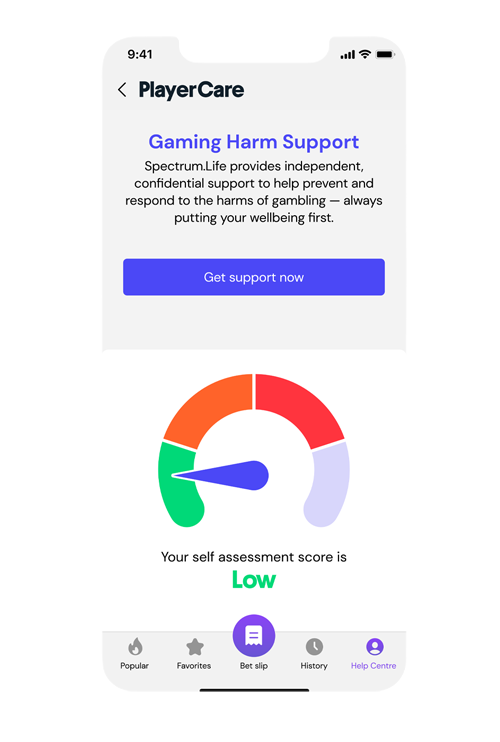
Self-check tool with green/amber/red risk
Curated support libraries
Transparent, Auditable Data & Decisioning
Live MI dashboards.
Fully auditable trail of interventions
Plugs into existing systems
Frequently Asked Questions
Our mission is to save and changes as many lives as possible. PlayerCare is how we bring our mission to gambling harm. PlayerCare was built as a clinical service first, not a commercial bolt-on. It intervenes early, reduces harm, and supports recovery — at the point of play.
PlayerCare isn’t another widget or dashboard. It’s a structural upgrade to how safer gambling is delivered, defended and perceived. Our belief is clear: if the industry wants to be sustainable in the long term, clinical care must sit at its core.
For years, gambling operators have invested in AI-driven risk detection, affordability checks and exclusion tools. They have their place, but they all stop at the same point: they flag a problem and hand the responsibility back to the operator. That ‘last mile’ between identification and meaningful support is where risk escalates. PlayerCare was created to close that gap with clinically governed intervention.
Born from a partnership between Spectrum.Life, Europe’s largest mental-health provider, and RPM Gaming, it combines clinical infrastructure and decades of gambling expertise. The result is the first clinically governed, evidence-based harm-reduction platform and intervention layer in gambling.
PlayerCare replaces reactive penalties with proactive, judgement-free support to create lasting change for players. The platform checks in using brief, evidence-based screening questions and offers help at the right moment rather than after a crisis. If a risk is flagged, the player is offered personalised options: a quick chat with a trained counsellor, an in-app self-help module, financial tips, or a live call at a time that suits them – even outside normal office hours. Everything is culturally sensitive and confidential.
This approach reduces stigma by making support feel like a routine health service, not a disciplinary measure. It lets players decide what level of help they want and when, so they stay in control of their play rather than being abruptly blocked or shamed. For many, that difference – being met with respect and practical support instead of punishment – is what makes them actually use the help on offer.
From day one the vision was clear: detection isn’t protection. PlayerCare brings the standards of healthcare into gambling, following NICE NG248, WHO guidance and stepped-care models already proven in mental health and addiction.
- Evidence-based pathways – validated screening (PGSI, SOGS, Lie-Bet) and NICE-recommended interventions (motivational interviewing, digital CBT, relapse-prevention planning).
- Proportionate support – not every risky behaviour triggers exclusion; sometimes the right step is a nudge, a check-in or a coach, sometimes it’s therapy.
- Clinical governance – interventions designed and overseen by independent clinicians; decisions grounded in ethics and medicine, not just compliance checklists.
PlayerCare follows the same stepped-care principles used in public health and addiction services:
- Step 1: Identification & Brief Intervention
Routine and targeted screening (PGSI, Lie-Bet), psycho-education content, motivational interviewing and self-help resources. - Step 2: Low-Intensity Psychological Interventions and 24/7 Access to a Clinician
Guided self-help programmes, digital CBT modules, telephone/online support, family resources. - Step 3: High-Intensity Psychological Interventions
Individual CBT for gambling disorder, mindfulness-based interventions, relapse-prevention strategies, counselling for families. - Step 4: Specialist & Intensive Support
Multidisciplinary team involvement (clinical psychologists, addiction specialists), psychiatric assessment for co-occurring conditions, inpatient or structured day programmes when needed.
This model ensures people get the least-intensive effective support first, progressing to more intensive care only as necessary – reducing stigma and avoiding unnecessary bans or exclusion.
The Stepped Care model supports players by directing them to the most appropriate support level for their needs and escalating where necessary. This prevents players from receiving ‘one-size-fits-all’ support and ensures they have the right level of care from day one.
This reduces stigma by making support feel like a routine health service, not a disciplinary measure. It helps players stay in control of their play rather than being abruptly blocked or shamed.
Across the gambling industry a quiet shift is underway. Instead of blocking or excluding players only after harm becomes obvious, some operators are embedding health-service-grade prevention models directly into their platforms.
Operators reduce unnecessary self-exclusions and extend the lifetime value of players who can gamble safely, while strengthening compliance defences. Every interaction is logged and auditable, smoothing licence renewals and regulator audits.
For operators the economics are stark. Every month, self-exclusions can cost millions in lost value. By intervening earlier with low-intensity, evidence-based supports – digital CBT modules, financial-risk education, family support resources – PlayerCare reduces unnecessary exclusions, extends the lifetime value of players who can gamble safely, and strengthens compliance defences. Every interaction is logged and auditable, smoothing licence renewals and regulator audits.
Regulators and journalists see verifiable proof of duty-of-care. Outcome measures such as PGSI score reduction, uptake of relapse-prevention plans and mental-health improvements can be tracked at population level. This reframes the story from “penalties and fines” to health-led, evidence-based harm prevention.
For regulators, journalists and the wider public, PlayerCare signals that the industry can be proactive rather than merely reactive. Because the service is anchored in NICE guidelines and independent clinical governance, outcomes such as reduced gambling-harm scores, uptake of relapse-prevention plans and improvements in mental health can be tracked at population level.
Since launch PlayerCare has been refined with input from regulators, platforms and operators across the UK, Europe, North America and APAC. It can:
- Deliver real-time stepped care – from nudges and digital self-help to live 24/7 therapy aligned with NICE guidelines.
- Create audit-ready logs – every action consented, time-stamped and regulator-proof.
- Fully white-labelled and brand-controlled with SDK/API integration layers
Today, PlayerCare is market-ready and already being positioned as a new global benchmark for safer, clinically governed gambling – a platform that supports people with evidence-based care.
For too long “responsible gambling” has meant algorithms that spot risk but do little to protect people once flagged. Detection alone isn’t protection. PlayerCare was built to change that – bringing the rigour of healthcare into gambling harm prevention.
Evidence-Based and Data-Driven – PlayerCare is designed around the National Institute for Health and Care Excellence (NICE) guidelines and WHO recommendations on gambling-related harm. Every screening tool, brief intervention and referral pathway is selected because it has a published evidence base – from the Problem Gambling Severity Index (PGSI) to digital CBT and motivational interviewing modules. Continuous data monitoring helps refine risk profiles and match individuals to the least-intensive effective support first, stepping up only when needed
Clinically Appropriate, Not Punitive – Not every marker of risk should trigger exclusion. Sometimes the right step is a timely nudge, a confidential check-in or a self-help module; sometimes it’s structured therapy or multidisciplinary care. PlayerCare’s stepped-care model routes people into the right pathway at the right time, avoiding unnecessary bans that can compound stigma or push gambling underground.
Independent Expertise and Mental-Health Standards – All interventions are developed and overseen by independent mental-health clinicians. Decisions are grounded in ethics and medicine, not marketing or compliance checklists. This gives operators a defensible, auditable duty-of-care system and gives players confidence they are being treated according to health-service standards.
Compassionate Support for the Person, Not Just the Problem – At the heart of PlayerCare is a simple principle: people deserve care, not censure. Players receive support that is human, proportionate and respectful – available 24/7, culturally sensitive, and confidential. The service doesn’t just “manage risk”; it helps individuals stay in control, recover when needed, and feel genuinely cared for rather than punished.
Our immediate goal is straightforward: roll out PlayerCare with Tier-1 operators and platform providers. We’re already in advanced conversations across multiple regulated markets where demand is growing for solutions that do more than tick compliance boxes.
The longer-term goals are clear and bold – to make PlayerCare the global gold standard for gambling-harm reduction. That means:
Sustainable economics – Helping operators reduce the financial hit of exclusions, improve retention and protect revenue streams by intervening earlier with proportionate, evidence-based support.
Smarter interventions – Building AI-driven wellbeing profiles that predict harm earlier, personalise interventions and continuously learn – always underpinned by NICE-aligned, clinician-approved pathways.
Global adaptability – Whether it’s a U.S. state regulator, an EU ESG directive or an APAC government-led model, PlayerCare can flex to local requirements while maintaining a consistent clinical standard and audit trail.
Trust and ESG – Supporting operators to prove they don’t just comply – they genuinely care. That’s a powerful message not only for regulators but also for investors, employees and the communities they serve.
Ready to Lead in Safer Gambling?
PlayerCare is compliance you can prove and care you can trust.
Talk to us today
- No disruption to your brand UX, game flow, or onboarding.
- Tailored to your brand, journey and jurisdiction.
- Full clinical and technical support included.